Sumo Grammar

Sumo Grammar

Japanese grammar, the way Japanese schools teach it

Eight books, from a first sentence to N1 and beyond, then classical Japanese and kanbun. Every lesson is one page: short explanations, examples read aloud, every word’s meaning a tap away, then a few questions.

For iPhone, iPad and Mac · Book 1 free

Try it here

Read a page, hear every word

The first lesson of Book 1: its point and its examples, as the app shows them. Tap any word for its meaning and its reading, and to hear it; tap the speaker for the whole sentence. Then cut a sentence into its phrases, the way Japanese students do.

Book 1 · Lesson 1-1

文ぶん・文節ぶんせつ・単語たんごSentence, phrase and word

The point

A sentence (文ぶん) is made of phrases (文節ぶんせつ), and a phrase of words (単語たんご). Cut a sentence wherever you could say 「ね」: each piece is a phrase.

  • 。

    Flowers bloom.

  • 。

    I am a student.

  • 。

    My little sister drinks milk every morning.

Every word with a dotted line has its meaning on a tap, in every lesson of the app.
練習問題れんしゅうもんだいPractice

1

Cut the sentence into its phrases (文節ぶんせつ).

Tap between words to cut, then Check.

私わたしは本ほんを読よむ。

I read a book.

From Book 1, lesson 1-1

The course

Eight books, from a first sentence to classical Japanese

Books 1 to 5 climb the JLPT levels, N5 to N1, the way school has years. Book 6 goes past N1, into the Japanese of news, essays and laws; Books 7 and 8 read classical Japanese (古文こぶん) and classical Chinese the Japanese way (漢文かんぶん), as Japanese high schools teach them.

1N5

Book 1 · 13 chapters · 64 lessons · Free

文ぶんのかたち The shape of a sentence

What a Japanese sentence is made of, and the first patterns: です, ます and the basic particles.

  1. Sentences and their parts
  2. Noun sentences
  3. This, that, and words for people
  4. Describing sentences
  5. There is, there are
  6. Verb sentences
  7. Verb groups, the school way
  8. Patterns with て
  9. Particles together
  10. Question words
  11. Joining sentences
  12. Comparing, changing, how much
  13. Numbers and time
  • 8books, from N5 to classical Chinese
  • 105chapters
  • 512lessons, each one page
  • 64lessons free in Book 1
  • 5 to 7questions after every lesson

The school way

Grammar the way Japanese students learn it

Japanese schools teach grammar (学校文法がっこうぶんぽう) with a few clear ideas, each with its own name. Sumo Grammar teaches with the same ones from its first page, so the terms you learn are the ones a Japanese textbook uses.

  1. 1

    Take a sentence apart

    A sentence (文ぶん) is made of phrases (文節ぶんせつ), and a phrase of words (単語たんご). Where you could say 「ね」, a phrase ends.

    To a Japanese student, 「行いきます」 is two words: 「行いき」, the verb go, and 「ます」, which makes it polite.

    Book 1, lesson 1-1

    1. 文ぶんsentence私わたしは学校がっこうに行いきます。
    2. 文節ぶんせつphrases私わたしは学校がっこうに行いきます。
    3. 単語たんごwords私わたしは学校がっこうに行いきます。
  2. 2

    Sort the words

    Every word is one of ten parts of speech (品詞ひんし). Eight can make a phrase alone (自立語じりつご); two only ever come after another word (付属語ふぞくご). Four change their endings.

    Book 1, lesson 1-5

    自立語じりつご · stand alone

    • 名詞めいしnoun本ほん・私わたし
    • 動詞どうしverb書かく・見みる
    • 形容詞けいようしi-adjective高たかい
    • 形容動詞けいようどうしna-adjective静しずかだ
    • 副詞ふくしadverbとても・ゆっくり
    • 連体詞れんたいしpre-noun wordこの・大おおきな
    • 接続詞せつぞくしconjunctionでも・だから
    • 感動詞かんどうしinterjectionああ・はい

    付属語ふぞくご · come after a word

    • 助動詞じょどうしhelper verbです・ます
    • 助詞じょしparticleは・が・を

    changes its ending (活用かつよう)

  3. 3

    Learn how they change

    A verb changes its ending to fit the word after it, and school grammar sets it all out in one table: the conjugation table (活用表かつようひょう), the six forms across, the five kinds of verb down, and under each form the words that follow it.

    Book 1, lesson 7-1

    Kind未然形みぜんけい連用形れんようけい終止形しゅうしけい連体形れんたいけい仮定形かていけい命令形めいれいけい
    五段ごだん: 書かく書かか・書かこ書かき・書かい書かく書かく書かけ書かけ
    上一段かみいちだん: 起おきる起おき起おき起おきる起おきる起おきれ起おきろ・起おきよ
    下一段しもいちだん: 食たべる食たべ食たべ食たべる食たべる食たべれ食たべろ・食たべよ
    カ変へん: 来くる来こ来き来くる来くる来くれ来こい
    サ変へん: するさ・し・せしするするすれしろ・せよ
    What followsない・う・ようます・た・てthe end: 「。」a noun: ときばan order: 「。」

Practice

Answer it, see why, and see it again

Every lesson ends with five to seven questions, answered on the page: marked at once, the right answer shown, and why. Here is one of each kind, from Book 1.

1

Choose what goes in the gap.

私わたし学生がくせいです。

I am a student.

From Book 1, lesson 2-1

The Practice tab brings them back

Every question you answer in a lesson comes back in the Practice tab: the ones you missed first, the others after a day, three days, a week and more. Each go is 10 questions, mixed across your lessons.

  1. Todayanswered in its lesson
  2. 1 daylater, if right
  3. 3 dayslater, if right
  4. 1 weeklater, if right
  5. 2 weekslater, if right
  6. 1 monthlater, if right
  7. 2 monthsand every two months after

Missed one? It comes back soon, ahead of the rest, and starts its days again.

The Index

Every pattern and school term, and where it is taught

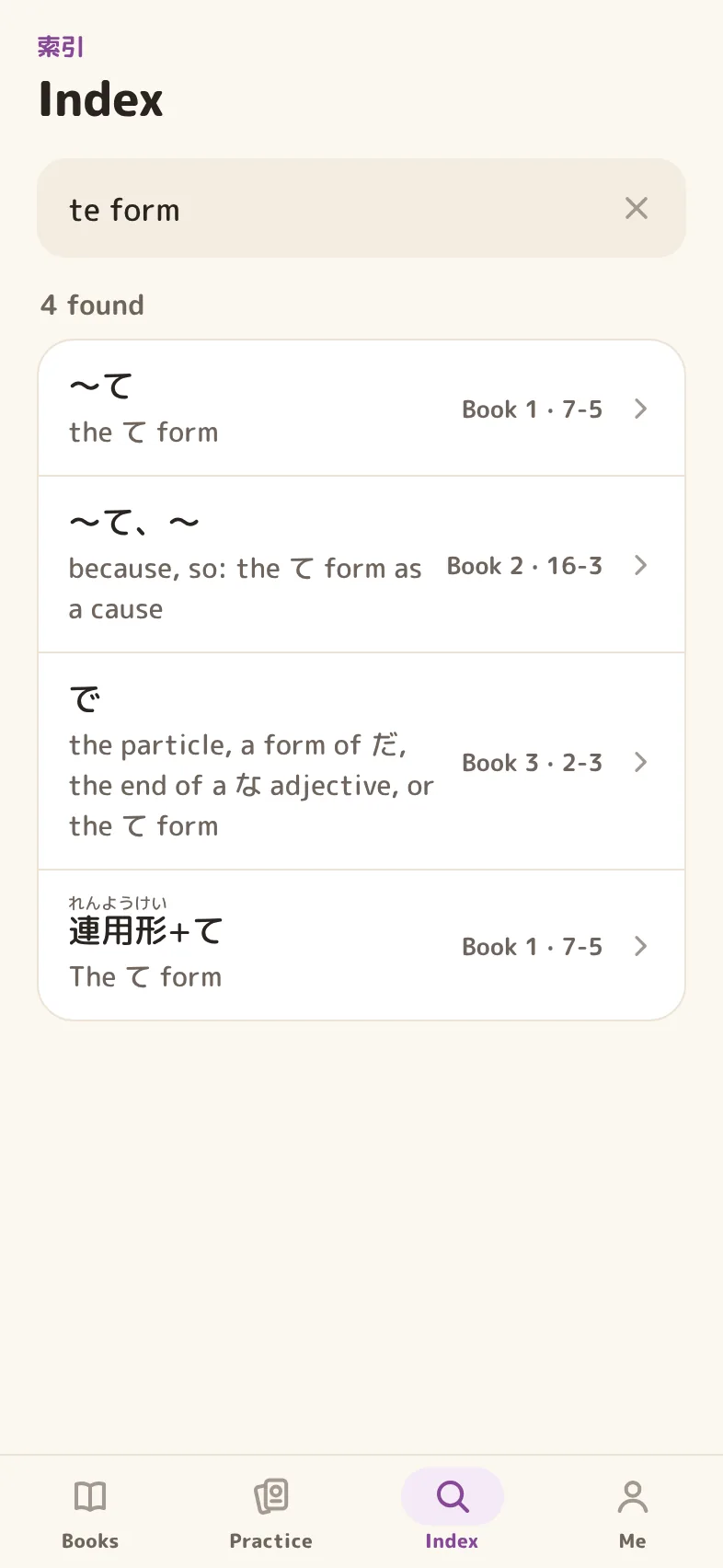
Look a pattern up by its Japanese, its romaji or its English, or a school term by its name, and go straight to the lesson that teaches it.

Search for

What the Index finds in Books 1 and 2.

84 found

  • 〜にa な adjective before a verb: quietly, neatly ...Book 1 · 4-5
  • にin, at: where something isBook 1 · 5-2
  • にto (a place); at, on, in (a time)Book 1 · 6-3
  • 〜に〜がありますin (a place) there isBook 1 · 5-2
  • 〜に〜がいますin (a place) there is (someone)Book 1 · 5-2

Inside the app

A book you can listen to

Four tabs: Books for the eight books, Practice for the questions coming back, the Index for every pattern and term, and Me for your progress.

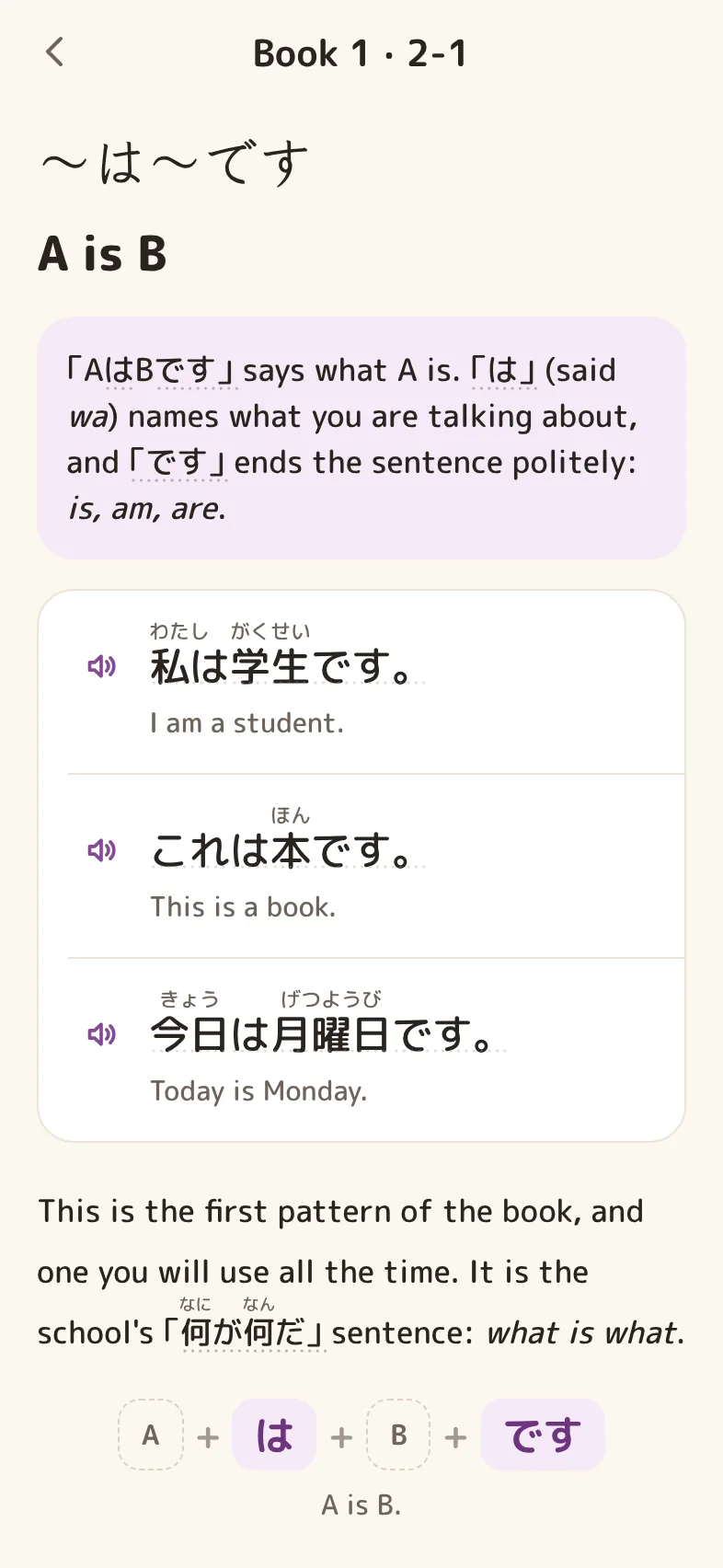
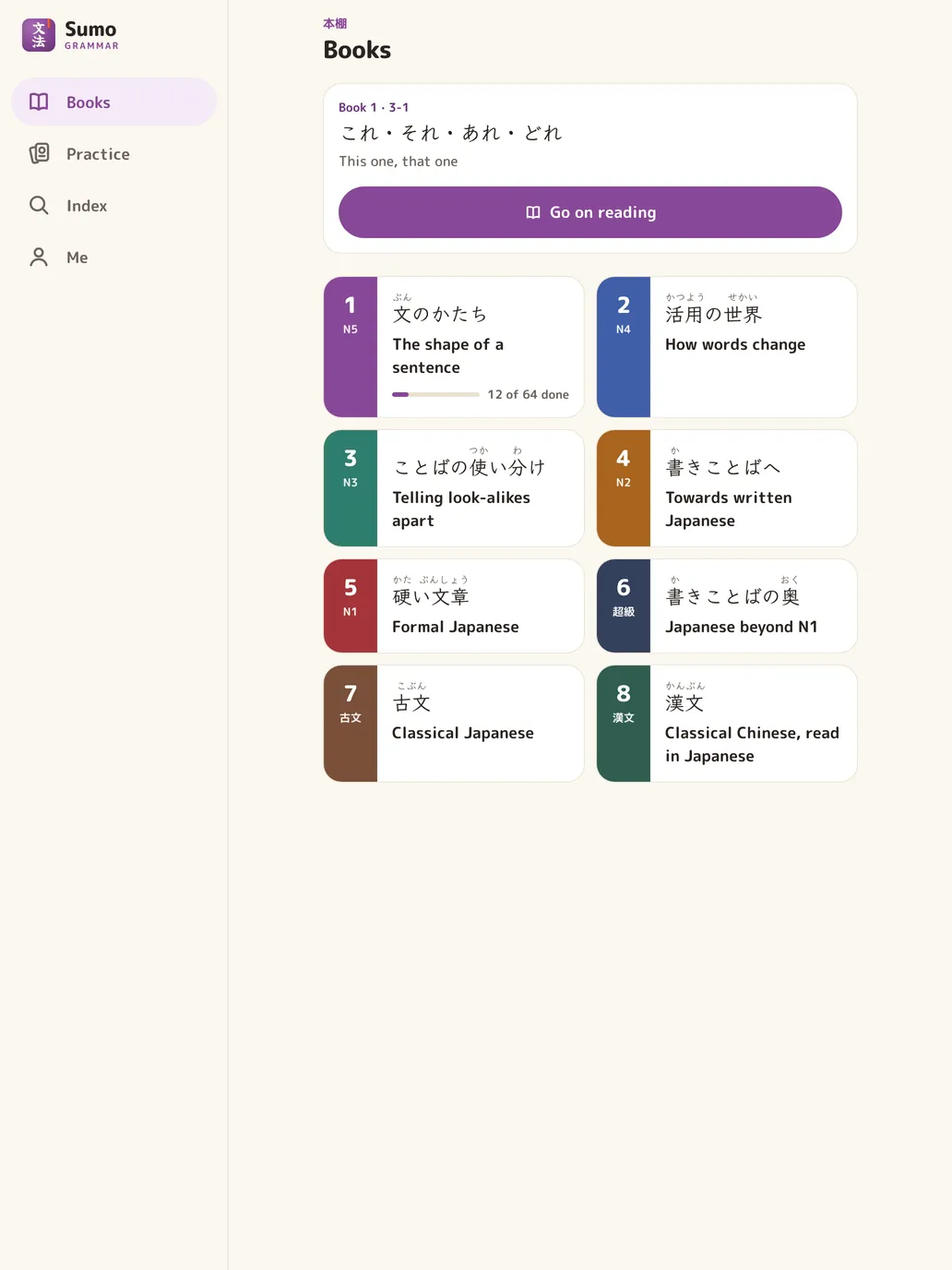
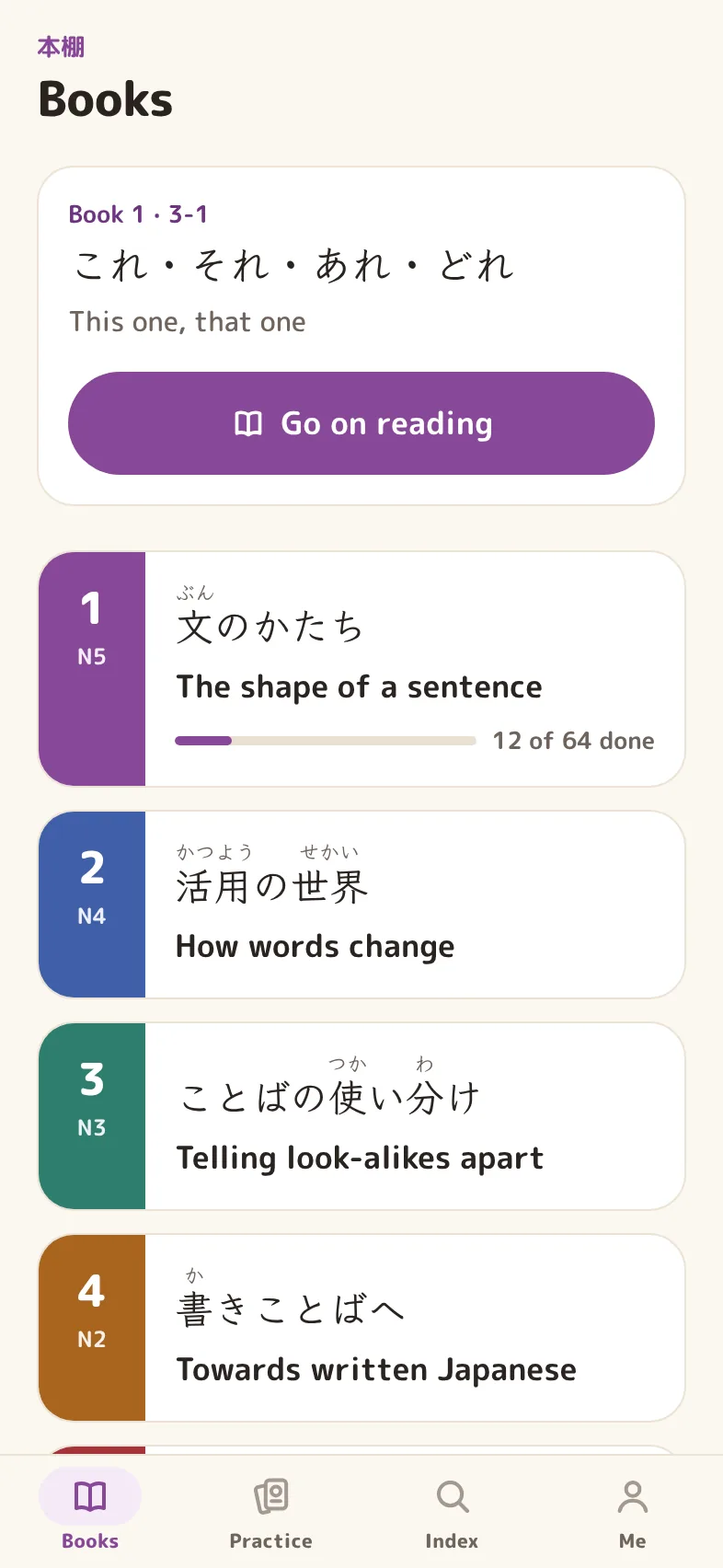
  1. The Books tab: the lesson to go on with, then the shelf of books, Book 1 begun with 12 of its 64 lessons done

    Eight books on your shelf

    The lesson to go on with, then every book with how far you have got in it. Book 1 is free.

  2. A lesson page: its title, the point, and examples on white cards, each with its speaker

    A page for every lesson

    The point first, then short explanations, examples read aloud, and a summary at the end.

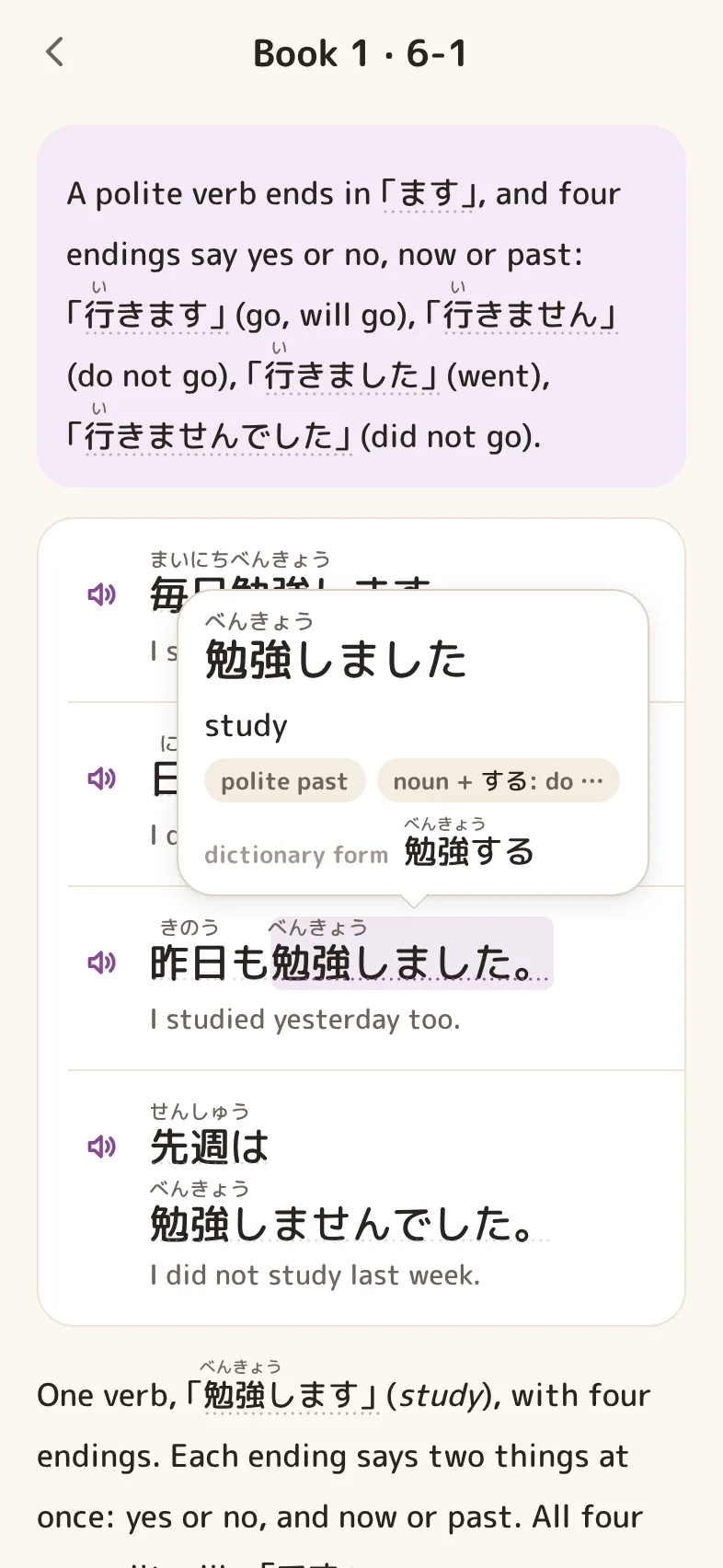
  3. A word tapped in an example: a bubble with its reading and meaning

    Every word, on a tap

    Tap any word of any example for its reading and meaning, and to hear it.

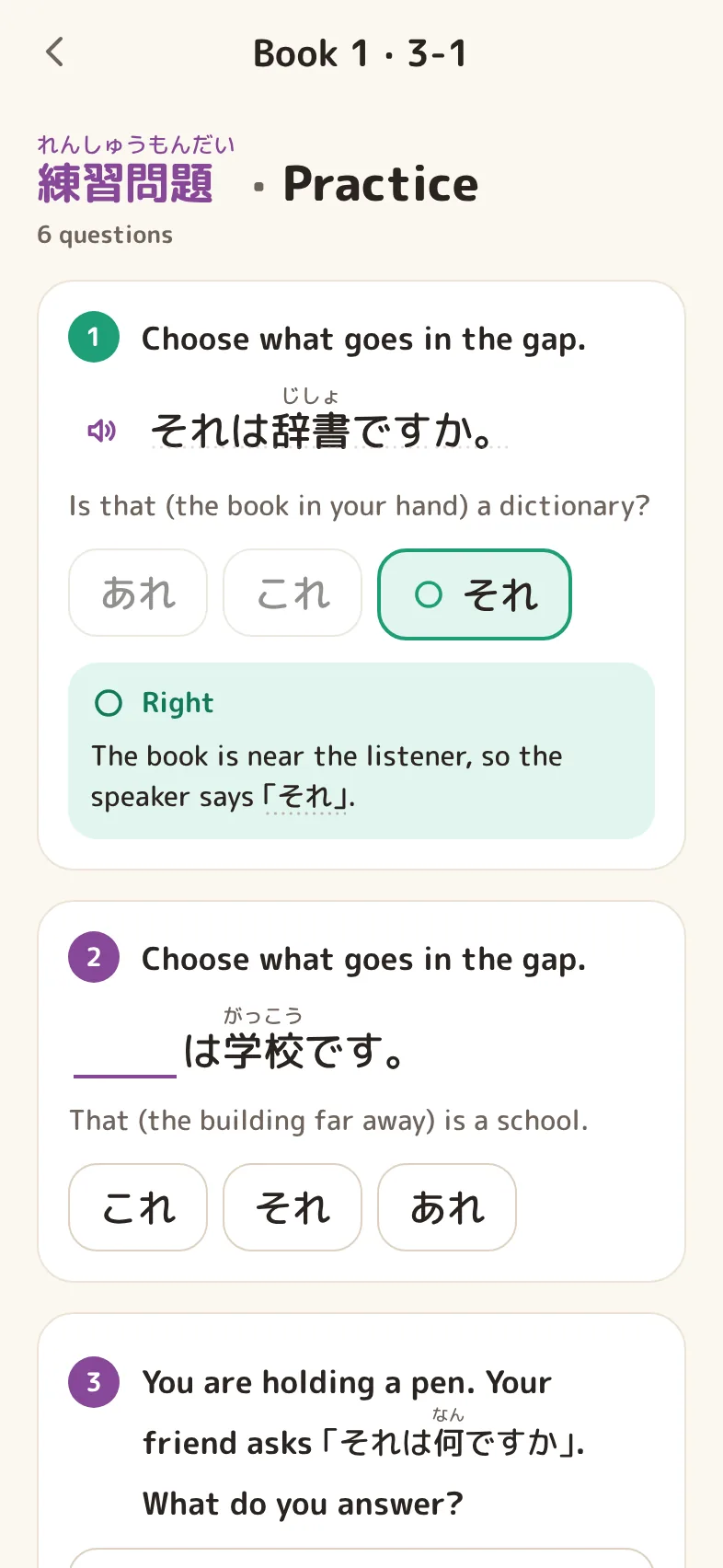
  4. The practice after a lesson: a question answered, marked and explained

    Practice after every page

    Five to seven questions, each marked at once, with the right answer and why.

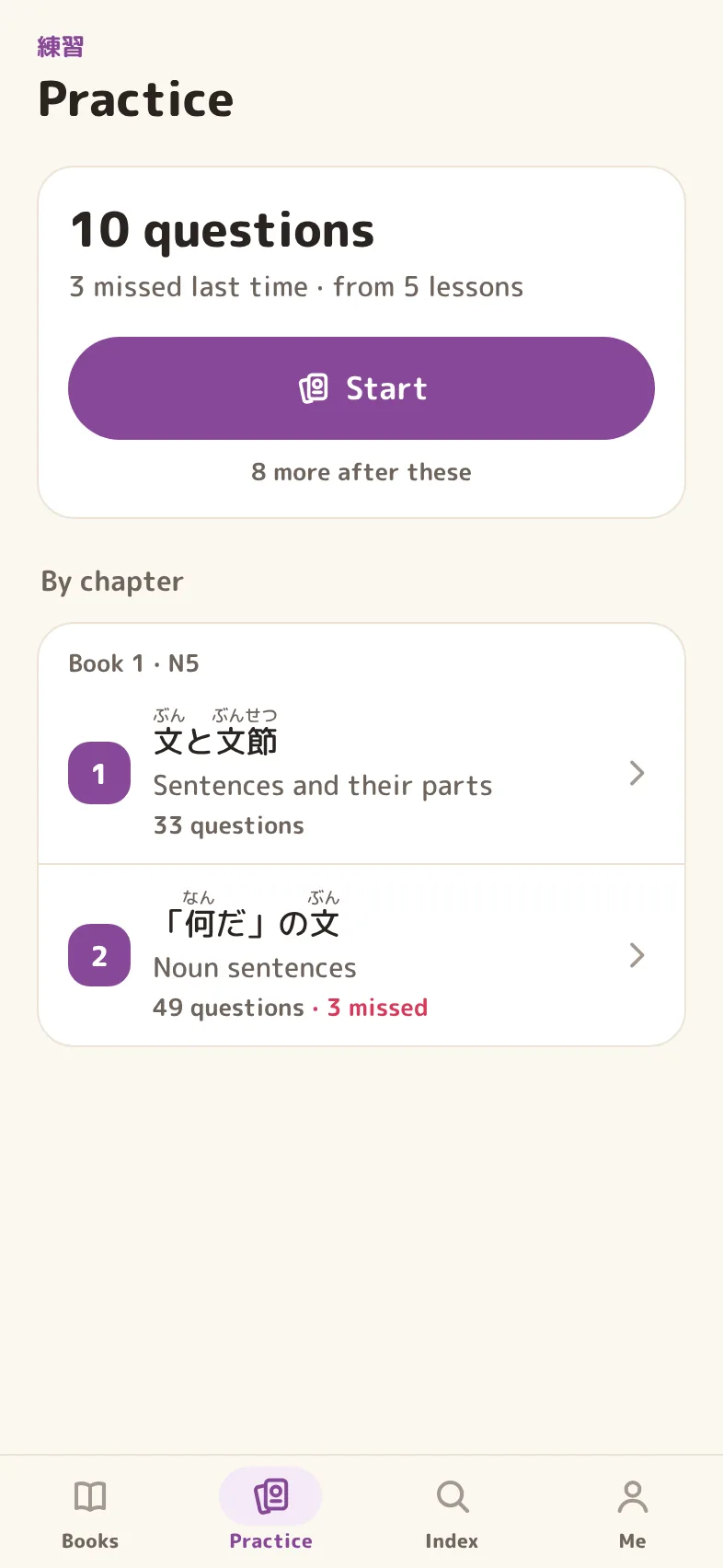
  5. The Practice tab: today’s questions from the lessons read

    Back over the days

    The Practice tab brings every question back: the missed ones first, the others after a day, three days, a week and more.

  6. The Index: a search and the patterns it finds, each with its lesson

    An index of everything

    Every pattern and school term, found by its Japanese, its romaji or its English.

iPhone · iPad · Mac

On iPhone, iPad and Mac

The same eight books on all three. The four tabs, Books, Practice, the Index and Me, sit at the bottom of the screen on iPhone and in a sidebar on iPad and Mac.

Sumo Grammar Pro comes with you: restore it on each device signed in with the same Apple Account. On a Mac, Sumo Grammar runs as the iPad app on Macs with Apple silicon.

Yours, and only yours

  • No account

    Open it and start reading. There is nothing to sign up for.

  • Works offline

    Every page, every word’s meaning and every recording is in the app. It works on a plane.

  • No ads, no tracking

    Nothing about you is tracked or sold. What you read and answer stays on your device.

Sumo Grammar Pro

Book 1 is free, for good

Sumo Grammar Pro opens the other seven books, for US$9.99 a year, with your first 7 days free.

Free, for good

  • Book 1 (N5): all 64 lessons and their practice
  • The Practice tab, bringing the questions back
  • The Index of every pattern and school term
  • Every example read aloud, every word’s meaning on a tap

Sumo Grammar Pro

7 days freethen US$9.99 a year

  • All eight books: 512 lessons
  • N4 to N1, then Japanese past N1, classical Japanese (古文) and kanbun (漢文)
  • Cancel anytime in your App Store settings

An auto-renewing subscription, bought in the app. Cancel at least 24 hours before the trial ends and you won’t be charged. Prices in US dollars: the App Store shows yours.

Questions

Do I need to know any Japanese?

It helps to read hiragana. Book 1 starts from what a sentence is made of; readings sit over every kanji, and every example is read aloud and can show its romaji too.

What is “the way Japanese schools teach it”?

School grammar (学校文法がっこうぶんぽう): a sentence is cut into phrases and words, every word is one of ten parts of speech, and the words that change follow one table. Sumo Grammar teaches with the same terms, in the order a Japanese grammar textbook goes, then goes on to classical Japanese and kanbun as high schools do.

Which levels does it cover?

Books 1 to 5 follow the JLPT levels, N5 to N1. Book 6 goes past N1: the Japanese of news, essays and laws. Book 7 is classical Japanese (古文こぶん) and Book 8 classical Chinese read in Japanese (漢文かんぶん). 512 lessons in all.

Is every example read aloud?

Yes, every example and every word, in a clear Japanese voice made with Kokoro, an AI voice. The recordings are inside the app, so they play offline.

How does Practice work?

Every question you answer in a lesson comes back in the Practice tab: the ones you missed first, the others after a day, then three days, a week, two weeks, a month and two months. Each go is 10 questions, mixed across your lessons.

Does it need the internet?

No. Every page, every meaning and every recording is inside the app.

Is there an account?

No. Open it and start reading: what you read and answer stays on your device.

How does the free trial work?

The trial opens all eight books for free. Cancel at least 24 hours before it ends and you won’t be charged. With notifications on, the app reminds you two days before.

How do I cancel Sumo Grammar Pro?

On iPhone and iPad: Settings → your name → Subscriptions. On a Mac: the App Store → your name → Account Settings → Subscriptions. Cancel at least 24 hours before it renews.

I found a mistake. Where do I tell you?

Thank you! Write to us with the lesson, the sentence and what is wrong: we fix mistakes in the next update.

Your first page is waiting

Start where Japanese students start: what a sentence is made of.